
Showing posts with label Carrie Olivia Adams. Show all posts
Showing posts with label Carrie Olivia Adams. Show all posts
Saturday, April 11, 2026
some author activity: Barwin + Nećakov, Harder, Ebbitt, Koss, Adams + Pirie,

Saturday, August 31, 2024
some author activity: Brenner, Adams, Smith, Pirie, McElroy, Pittella, Banks + Rhodes,

Saturday, November 27, 2021
some author activity: Dreiblatt, Adams, mclennan, Nećakov, Novak + Hofmann,

Saturday, January 2, 2021
some author activity: Adams, Desbarats, mclennan + hanna,

Saturday, November 7, 2020
some author activity: Coulton, fitzpatrick, Adams + mclennan,

Saturday, June 29, 2019
some author activity: Siklosi, Adams, Ross + Dennis,

Saturday, June 30, 2018
some author activity: Archer, McFadden, Adams + Flemmer,

Wednesday, April 11, 2018
above/ground press 25th anniversary essay: Carrie Olivia Adams
This is the sixteenth
in a series of short essays/reminiscences by a variety of authors and friends
of the press to help mark the quarter century mark of above/ground. See links to the whole series here.

Just as no one
becomes a poet to make money, no one becomes a poetry publisher to make money.
And so, it is a discipline that inherently attracts those that are drawn to it
as a calling and those who believe in poetry for poetry’s sake alone. Yet, even
in a discipline composed almost entirely by people who have come to it out of
shear desire and admiration, rob mclennan stands out as someone whose
commitment to poetry and its potential readership is powerfully unique and
true. And as a result, his love and belief in poetry has grown a community that is remarkable for its inclusivity.
Though there
are more people studying and writing poetry than ever before, I fear that the
readership for poetry has not grown in accordance. Instead, just as we have
become enclosed in our own small news media bubbles, many of us poets, myself
included, are too often caught in our own incestuous poetry worlds when it
comes to the books and journals we read. Through above/ground press and Touch the Donkey, rob offers an anecdote
to this. His strength as a publisher and editor is having a wide vision—one
that is not tied to any particular geography or region, not tied to any
aesthetic or cool cohort, and one that encompasses age and profile. Emerging or
established, old school or new—for rob it’s about the work itself. It’s about
what poetry can do and the readers it can find and create.
And this takes
incredible work and time and attention—to find and solicit writers, to paginate
and fold those pages, and to stuff all of those many, many envelopes. It seems
like every week at least one of those joyful white envelopes is in my mailbox—a
regularity and a productivity unmatched in the publishing community. I feel
incredibly lucky that rob reached out to me for an interview after my first
book Intervening Absence was
published almost ten years ago. It established a creative and encouraging
friendship for which I am grateful. We, as poets, are all lucky to have him as
our champion and as a champion of the art to which we’ve all devoted large
parts of our hearts and lives. Cheers to 25 years! Let’s hope for many more.

Carrie Olivia Adams is a Chicago-based freelance book
publicist and the poetry editor for the small press Black Ocean. She is the author of Grapple
(above/ground press 2017) and Overture in the Key of F (above/ground press 2013) as well as the full-length
collections Operating Theater (Noctuary Press 2015), Forty-One Jane Doe’s (book and companion DVD, Ahsahta 2013) and Intervening Absence (Ahsahta
2009).
Tuesday, December 6, 2016
Cary Fagan reviews Carrie Olivia Adam's Grapple (2016)

Carrie Olivia Adams, Grapple. Ottawa: above/ground press, 2016.
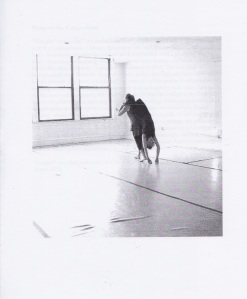
abovegroundpress.blogspot.comIt is notoriously difficult to capture one art form in another; can one do more than search for clumsy equivalents, fractured reflections? And yet when I read Carrie Olivia Adams’ Grapple for the first time, it was if I could see the movement and struggle of bodies in my mind. Not only the words themselves but the placement of the lines, fragments across a wide page, evoked extension and constriction, stillness and action.My first reading was without benefit of the “Notes on the Composition” which comes after the eight-page poem. I did have the image on the cover, and two inside, to know this was a dance in words. And the epigraph by Nawal El Saadawi told me that the poem was about movement and passivity, surrender and resistance. But it was only upon reading the notes that I understood the poem to actually be a text that had accompanied a dance performance–a performance inspired (if that’s the right term) by the arrest of “a young African American man during a protest as part of Moral Mondays Illinois in Chicago in November 2015.”The poem begins with two definitions of the title–“to stop the progress or movement of / (something)” and “to attract and hold the attention of / (someone or something).” This apparent contradiction, or mirror-imaging, is carried on throughout, with “strength” linked to “vulnerability” and going “limp” being an “act of resistance / …an act of / strength”. There is a particularly telling moment whenWe cannot see your face you cannot see ours pressedBut we are so closeThese words seem to me both powerful, frightening, and almost beautiful. On the poem’s next page, however, the poet becomes somewhat less nimble, writing in true, if sloganeering fashion, of a city that “forgets / the backs on which it is built”. But then the poet becomes more suggestive again:Tell us again how you knowhow you submerged us
how we re-wrote the movement of sidewalk and street
how it bent up to meet usThese words were spoken to a dance created by Chicago choreographers Jamie Corliss and Lydia Feuerhelm, who were also the performers. According to the “Notes,” the dance and the words were intended to “work with and against each other,” echoing the tension within the poem itself. I certainly would have liked to see this performance in which “intimacy and aggression overlap” but the poem works well on its own, especially with the accompanying photographs. It is a work that, while for the most part not allowing its political purpose to diminish its artistry, never forgets that purpose.
Friday, October 28, 2016
new from above/ground press: GRAPPLE, by Carrie Olivia Adams

Carrie Olivia Adams
$4
Come back to the space
where we were so close
Tell us again how you know
how you submerged us
how we re-wrote the movement of sidewalk and street
how it bent up to meet us
how our cries made a body an earthquake
What was that chain reaction?
Notes on the Composition
“Grapple” was written as a multidisciplinary poetry-dance work in collaboration with the Coincidentals, Chicago choreographers and dancers Jamie Corliss and Lydia Feuerhelm. Initially the dancers drew inspiration from a photo by Shayna Stacy of an arrest of a young African American man during a protest as part of Moral Mondays Illinois in Chicago in November of 2015. The text then incorporated ideas from the image alongside source material and videos provided by the dancers. Together, we adapted the structure of the poem to inform the building of the dance, so that the two work with and against each other. Using spoken text and movement, the resulting piece evokes the complex physicality of the act of protest where intimacy and aggression overlap. Street protest occupies a unique space in contemporary society, where strangers are fueled by a shared urgency, where limpness and release take the form of strength, where people defy norms by being so close. Rather than address the politics of protest, the piece in performance addresses the energy and feeling of these movements in a corporeal sense. It examines how physicality in protest exists in seemingly contradictory ways: bodily weakness can be an act of strength and physical closeness can unify or it can assert power hierarchies.
“Grapple” was first performed in Chicago as part of the Mess Hall series in August 2016.
published in Ottawa by above/ground press
October 2016
a/g subscribers receive a complimentary copy
Carrie Olivia Adams lives in Chicago, where she is a book publicist for the University of Chicago Press and the poetry editor for Black Ocean. She is the author of Operating Theater (Noctuary Press 2015), Forty-One Jane Doe’s (book and companion DVD, Ahsahta 2013) and Intervening Absence (Ahsahta 2009) as well as the chapbooks An Overture in the Key of F (above/ground press 2013) and A Useless Window (Black Ocean 2006).
This is her second chapbook with above/ground press, after An Overture in the Key of F (2013).
To order, send cheques (add $1 for postage; outside Canada, add $2) to: rob mclennan, 2423 Alta Vista Drive, Ottawa ON K1H 7M9 or paypal at www.robmclennan.blogspot.com
Saturday, August 15, 2015
some author activity: McKinnon, Barwin, mclennan, Adams, Dennis + Robertson,

Saturday, February 21, 2015
some author activity: timewell, mclennan, Paige, Earl, Adams + Smith,

Saturday, December 13, 2014
some author activity: Prevost, Adams, Rogal, Earl + the 2014 Indie Market,

Saturday, December 6, 2014
some author activity: Young, Tucker, Adams, Smith + Hajnoczky

Saturday, November 22, 2014
some author activity: Hajnoczky, Hancock, Ursuliak, Adams + Armantrout,

Saturday, September 13, 2014
some author activity: Hancock, Earl, Dolman, Adams, Kaminski, Wilkinson + Armantrout,

Saturday, June 14, 2014
some author activity: Schapira, Armantrout, dueck, Abel, Adams + Samuels,

Monday, May 12, 2014
Edric Mesmer discusses (briefly) six recent above/ground press chapbooks;

Edric Mesmer was good enough to mention six recent
above/ground press titles in the new issue of YELLOW FIELD (#nine; spring 2014):
An Overture in the Key of F by Carrie Olivia Adams; The State of Which by Hailey Higdon; Sugar Beach by Camille Martin; from Hark: a journal by rob mclennan; Overheard While Hiding from the Sun: post-notebook poems by Kate Schapira; and Albanian Suite by Hugh Thomas). Thanks, Edric! There are two previous reviews of Adams' title here and here, a previous review of Higdon's title here, two previous reviews of Martin's title here and here, two previous reviews of mclennan's title here and here, and a previous review of Thomas' title here, and copies of all are very much available! Also, you can pick up a
copy of the new issue of YELLOW FIELD through: yellowedenwaldfield [at] yahoo [dot] com or by
writing to 1217 Delaware Avenue, Apt. 802, Buffalo, New York 14209. For those
who haven’t been able to pick up an issue yet, I reprint such here:
6 more from above/ground press 2013-2014I love a small press, what it can say through its poetics—in this case, chapbooks answering the call of a contemporary lea. Consider a cache of birds, a quintet of strings; but the trope may or mayn’t be limited to birdsong, string, or color-tone…Sometimes there’s a poem in which Buffalo poet emeritus Bill Sylvester writes: “pepper linen incense lobster / lutes viols and ambergris […] what a messy party that would be!” And so we messily hear a great party of Darwinian diversity: “The formalist of formant when our lips make the vowel, it I the act of giving somewhere shape” (An Overture in the Key of F by Carrie Olivia Adams); “I did some trying to voice the regional things –accents and whatnot / I even tried to find that series of hybridized creatures, part person / part place that exist in the park” (The State of Which by Hailey Higdon); “viewing creation / / from a precisely-gauged periphery, clock ticking” (Sugar Beach by Camille Martin); “A stone made out of stone. The dream of people you can’t know. Prince Adolphus, Duke of Cambridge, Bay. We know you, myth. What lifestyle will not allow” (from Hark: a journal by rob mclennan); “Anyone can submit / a video to the Free Me Library. Can find / purchase for brilliance, can be avenged sevenfold or / touched relevantly. All that can be shelved in me” (Overheard While Hiding from the Sun: post-notebook poems by Kate Schapira); “cadence address catch dreams / pays and agree, chlorate of poems, / empathic, the old epidemic / things themselves” (Albanian Suite by Hugh Thomas).
Sunday, February 16, 2014
Scott Bryson reviews Marcus McCann’s Labradoodle: A Essay on David McGimpsey (2013), Wanda O’Connor’s damascene road passaggio, selections (2013), Carrie Olivia Adams’ An Overture in the Key of F (2013) and Gary Barwin’s Seedpod, Microfiche (2013) in Broken Pencil #62

Scott
Bryson was good enough to review Marcus McCann’s Labradoodle: A Essay on David McGimpsey (2013), Wanda O’Connor’s damascene road passaggio, selections (2013),
Carrie Olivia Adams’ An Overture in the Key of F (2013) and Gary Barwin’s Seedpod, Microfiche (2013) (copies of all of which are still very much available) in Broken Pencil #62. Thanks, Scott! This is actually the second review of Adams' book (by Joseph LeBine), as well as the second for McCann's title and Barwin's title (by Ryan Pratt). Who knew our books would be garnering so much attention?
This is an enormous amount of generous attention he
has paid to some worthy publications, and we thank him for it. Although I’m not
entirely sure why most of his qualitative judgements upon the works he chose to
discuss are based upon how well he was able to comprehend the poems; as though
figuring out the poem in a particular way (ie -- solving the puzzle of a poem) is more important than attempting to
approach each work on its own terms. Is comprehension, at least in the way
Bryson suggests, the first and foremost goal of reading poems? It reminds me of a response
Gertrude Stein gave to an interview, suggesting that if the reader enjoyed the
piece, then that is, by itself, understanding or “getting it.”
Labradoodle: A Essay on David McGimpsey
Marcus McCannLabradoodle’s subtitle, An Essay on David McGimpsey, may be accurate from a certain perspective, but it’s a tad misleading from most angles. This is certainly more of a poetry collection than an essay – Marcus McCann calls these “chubby sonnets” – and it’s more in the style of comedic writer David McGimpsey, than “on” David McGimpsey (save one biographical poem).Anyone familiar with McGimpsey’s poetry, or his “Self-Esteem Workout” column in Matrix Magazine, will know his jokes are typically a smokescreen for discussions on insecurities and tragic flaws. It’s a distinction that McCann suggests readers tend to miss: “People say, / Oh, David McGimpsey, he’s the guy who writes / funny poems. Which is a little like saying, / Hey, he’s the guy with the really funny cancer” (from “A primer on David McGimpsey for those who have never heard of David McGimpsey”).McCann’s collection straddles the same border between levity and tragedy. He finds a one-word note to himself on his Blackberry, for example, that reads “Cocktapus, and spends the greater part of a poem (“Three years ago, I was not quite ready to use the word labradoodle in a poem”) struggling to remember what it means, invoking Transformers and coming to terms with his immaturity. “Every day is a David McGimpsey poem,” he concludes, “and it’s half golden lab, and half whatever / ‘doodle’ stands for. It is not good news.”Labradoodle is a quick read – there’s little in the way of subtext – but its bemused attitude justifies multiple reads.damascene road passaggio, selections
Wanda O’ConnorNot many chapbooks require an explanatory essay (“subtext/pretext,” the author calls it), but the one Wanda O’Connor includes as an afterword to damascene road passaggio is definitely warranted, even if it’s somewhat obtuse.In her afterword, O’Connor describes this fragmented long poem as “a sequence of asides and sides that take as their companions letters addressed to no one… This project takes up Kafka’s intercourse with ghosts” (an “intercourse” Kafka once likened writing letters to). One would assume there’s also something opera-related happening here – passaggio is a term used to describe pitch ranges in classical singing. Another handy definition: a damascene road – better known as a road to Damascus experience – is a religious conversion, or a revelation about one’s self.A reasonable amount of research is clearly recommended before tackling this chapbook, though the above falls short of providing anything near complete comprehension. O’Connor’s writing isn’t necessarily highbrow – most of these words, lines and stanzas are completely graspable. What’s challenging is attempting to decipher how the fragments of this poem are all related, if they even are. O’Connor does call this “asides and sides,” so it’s probably best to read these verses without an expectation of interconnectedness.The text in damascene road passaggio echoes that fragmentation. Words and stanzas are scattered to the left, right and centre, and handwritten notes mingle with phrases, full sentences and typed correspondence. In spite of this fractured presentation, O’Connor’s verse is surprisingly fluid, which suggests that full understanding will come, eventually (after more research). Let it be said, at least, that this is poetry that teaches.
An Overture in the Key of F
Carrie Olivia AdamsIt’s amusing how blind we can be to the obvious. I was nearly all the way through this Carrie Olivia Adams collection (it’s best described as a lyric essay in parts) before I realized the significance of its title: every paragraph contains a word – often several – that starts with the letter F, and there isn’t a great deal of duplication.This device is a double-edged sword. The alliteration makes for a pleasurable read, but Adams quickly runs out of commonplace F words and resorts to atypical terms like “fungible” (having a dictionary handy while reading this is recommended). As a consequence of this forced use of F words, An Overture in the Key of F tends to provide impressions more than concrete details. Many of Adams’ lines are lists of items that suggest something unmentioned, or that operate as intricate metaphors: “Payment, ransom, bunting, linnet, find… A finger wave, utterly and finally. The scandal of pine.” There’s also definitely an atmosphere of remembering and forgetting present – of trying to put your finger on something fleeting: “The pernicious sound of something familiar, a grief in the breath-filled fading consonant of a lost name.”The air of mystery surrounding this text will be enticing for some – who doesn’t keep returning to a mystery, searching for answers? – but it runs the risk of alienating others. Whether you like or dislike An Overture in the Key of F will likely depend on how easily and quickly you give up. If there’s a detective in you, you’ll keep coming back.Seedpod, Microfiche
Gary BarwinChapbooks with gimmicks can be a risky enterprise, but Gary Barwin is no stranger to themed works. His Franzlations (2011), for example, was a collection built on Franz Kafka-isms.The six selections in Seedpod, Microfiche could either be viewed as the poetic version of a word ladder puzzle (the type of brain-teaser that asks you to change one word into another, in a certain number of steps, by altering a letter at a time) or a written game of Broken Telephone. Barwin is changing more than one letter at a time in these poems – he adds, removes and rearranges several words from poem to poem – but the effect is similar: the opening poem (titled “1”) is transformed, bit by bit over six pages, into a wholly different verse, while retaining a glimmer of its original meaning.This could be considered a safe approach to writing poetry, but it also provides some desirable security for the reader. There’s an extra level of satisfaction to be garnered from a set of poems that are intimately connected, and Seedpod, Microfiche delivers that gratification.The connectedness of these poems is of course assured by their shared foundation, but it’s also enhanced by the repetition of particularly imagery: the power of dew drops to magnify, fish swimming silently, and a stethoscope (used literally and metaphorically) that pops up in the closing stanza of each poem. The titular Microfiche appears repeatedly, as well, and the sentiments it generates are apt: zooming in; many from one; shining a light on part of a whole.
Subscribe to:
Posts (Atom)


