
Showing posts with label Cary Fagan. Show all posts
Showing posts with label Cary Fagan. Show all posts
Monday, January 5, 2026
above/ground press author spotlights : substack : Trivedi, Houglum, Tierney, Christie, Gray, Reid, Unsworth, Ballard, O’Reilly, Ladouceur, Sikkema, Siklosi, Norris, Nećakov, Saklikar, Fagan, Earl + Downs,

Tuesday, December 16, 2025
Alina Stefanescu : Above/groundings.
.webp)
Thursday, November 6, 2025
new from above/ground press: The Sun Will Bleach It Away, by Rebecca Comay / Cary Fagan

Rebecca Comay / Cary Fagan
$6
Beer, light, Portuguese, German, English; how brittle is old paper in the seller’s hand.
The battered brass weight hung so heavily between her fingers.
Authors’ Note
In February and March of 2019, we spent several weeks in Lisbon. One of us wrote a sentence in a blank notebook and handed it to the other who wrote a sentence in return. This handing back and forth occurred about once a day until we left the city for home.
published in Ottawa by above/ground press
November 2025
a/g subscribers receive a complimentary copy
Rebecca Comay teaches philosophy and comparative literature at The University of Toronto. Her books include Mourning Sickness: Hegel and the French Revolution (Stanford UP) and The Dash-The Other Side of Absolute Knowing (with Frank Ruda, MIT Press). Her next book, On Persistence is the first of two essay collections forthcoming from Seagull Books. She is a co-editor of the chapbook house, espresso. More work can be seen at rebeccacomay.com
Cary Fagan is the author of eight novels and six story collections as well as many books for children. Just published are A Fast Horse Never Brings Good News (book*hug) and Robot Island (Tundra Books). His novel, Still the World, will appear in 2027. He is a co-editor of the chapbook house, espresso, and the publisher of Found Object, which focuses on bringing work back into print. His books can he seen at caryfagan.com.
This is Fagan's third title through above/ground press, after Fifty-Two Lines About Henry (2024) and then / here / now / there (2025).
To order, send cheques (add $2 for postage; in US, add $3; outside North America, add $7) to: rob mclennan, 2423 Alta Vista Drive, Ottawa ON K1H 7M9. E-transfer or PayPal at rob_mclennan (at) hotmail.com or the PayPal button at www.robmclennan.blogspot.com
Sunday, April 27, 2025
Jay Miller reviews Cary Fagan's then / here / now / there (2025)

He makes it look effortless, but these poems are elastic balls of references, stories and allusions begging to be unraveled.
I have to steal this guy’s idea for a blog.
I don’t know how I’m only finding out about this now, but I am sat here this evening with Fagan’s 2025 above/ground chap then / here / now / there and reading his bio in the back to get a foot in the door to begin this draft and I wish I had stumbled upon this in my piles of books sooner.
Now I have to go read every review he’s written.
The words then and there are deictic opposites from now and here, a qualifier I don’t often have occasion to toss into casual conversation. There’s probably a pretty good XKCD chart floating around out there to illustrate my point.
But parlour yap isn’t the point of my writing tonight. I want to take a good look at this object in front of me, which has a sepia-like photograph on the cover of a dirt road banked up over a stretch of water running perpendicular to the viewer, with wooden railings on either side and a T-bone bridge structure at the vanishing point. It’s a very cozy picture that perfectly illustrates place and time by way of metaphor of a foot journey.
Opening the work, a cryptic message epigraphs the page opposite the first poem: various kinds of sake, it reads.
Let’s not get discountenanced so soon. It’s a curve ball, granted, but we’re in this reading together. We’re gonna make it.
The first poem has no title, which I am fond of (besides, titles are hard, as are opening lines, closing lines, and the stuff in between, in that order):
a man on tenth street planting begonias / how afraid
and yet desperate to get up before class / she’s trying
to learn harmonica / torn / you say to him, ’you are my
torturer’ / last night dreaming that i was dreaming of
my father / it isn’t necessary to finish war and peace,
is it? / when I have a good pen i want to write for its
sake
So many things happening here:
we are introduced to Cary Fagan’s style in this poem
the preference is for lowercase letters where possible
we have one capital I in the last line of the poem
the poet doesn’t mind having single-word lines in a poem
the poet doesn’t mind italics, which are multi-functional
but no periods, colons, semi-colons, or dashes
only slashes, commas, apostrophes, and a question mark
the last word bringing up the epigraph again, sake
It will be a small miracle if I don’t have to photograph the poem to get the typesetting to appear in its correct format from the book to the screen (Update: didn’t have to (on desktop)!).
All that being said, I think we have established sufficient ground rules to proceed on this mission together. What do his poems have to say?
Let’s circle back to this poem once we’ve looked at the next one the next page over:
sweetener / the marionette cellist dressed identically
to the man above / dink car left in a stocking by my
angry mother / yo, you have to be naked / getting the
4, 5, or 6 from astor place / i listen to solange because
sophie asked me / am i the only one who wants to be
thought of as nicer than i am? / the various kinds of
sake in the hiromi kawakami novel
So here we are once again woven sporadically through a biography that is in the process of being revealed to us through the slits of the blinds, one index finger peek at a time.
We are now immune to most orthographic devices because of the bulleted list we extracted from reading the first poem.
We are surprised, however, by the homograph plot twist of ‘sake’ being turned into a disyllabic loan word from the Japanese rather than the, I wanna say Norse Germanic, monosyllabic ‘sake’ we had assumed for the first two pages of the work.
We are provided more clues: astor place, a minuscule slice of New York; solange, the singer, no doubt; hiromi kawakami, a Japanese writer.
Now that we have encountered the two most obvious interpretations of the grapheme ‘sake’, I wonder what other various ‘sakes’ we’ll run into in the poems to follow.
Something about this chapbook, having been written by someone who occasionally reviews chapbooks, makes it feel like a treasure hunt. There’s a thrill to it. What we may discover.
In the least conventional line breaking manner, with as few safety railings against misinterpretation as possible, it does feel once again, to borrow the computer science phrase as I did the other day, like these poems operate pretty close to the metal (of the poetry machine).
This section ends, giving way to the next section, dutch novels. I realize now what I mistook for an epigraph is in fact a section header. It appears on the back of the page, or the left when the chap is spreadeagle, in all lower case letters, of course.
When I think of Dutch novels I can only conjure two to wit: In the Dutch Mountains, Cees Nooteboom, and Strike Out Where Not Applicable, Nicolas Freeling, the former being a Dutch writer of considerable repute and the latter being a novel set in the Netherlands and billed in the précis as “the thinking man’s Ian Fleming.” It’s all right so far, I just started it the other day. Sometimes no idea where the books I have come from to be quite frank.
Remembering the tangent I was on, I realize Fagan has stayed true to the title of his work: then takes place in these poems in the first two-three lines; here follows next, place taking priority over time; now is the natural segue from current physical location to current temporal; and there very much leads us astray, but not a red herring—it’s exactly as printed on the tin.
Taking it all in with a sharp inhale makes reading the following poem so much more relieving:
cars sluice through the college street rain / a cat
whose need is never sated / curve of the blade to make
the spoon’s bowl / tic tacs i carried around as a boy
like cigarettes / the splintered end of a season /
listening to allison de groot’s banjo / the air, the air
We can finally rest easy taking in the imagery, the metaphor, the combination thereof, the nostalgia, the unexplained use of italics, and the music tie-in, with a melodic enough coda to say Cary Fagan has tied it all off with a neat little bow.
The last poem of the section asks rhetorically at one point “why are there so many writers” and may or may not be a stray piece of unanswered dialogue.
There are two more sections proceeding, keeping true to the implied structure of the book. They are “any moment now” and “waiting by my father” and suddenly everything in this chap feels too brief. I want more. It’s not even over yet and I feel the impending, undesired burden of the abrupt end to come.
The other thing I notice about these words that may not appear explicitly to every reader is how prone this poetry would be to translation. There’s nothing ambiguous, despite the lack of orthodox structure; the poems aren’t long nor long-winded. Each page is one stanza, six lines apiece, and the last line sometimes only one word. It is perhaps a privilege of having been translated so frequently that Cary Fagan can write this way, he’s already familiar with the life and longevity of any given work.
As far as reviews go, I am no Colm Tóibín, although I truly wish I were. He would know exactly which bits to go after without giving an exegesis of every line in the work, even though he probably could. I am getting distracted again, aren’t I?
Something about reading Cary Fagan’s chapbook weakens my resolve to stay on topic. I want to gush about my own favourite writers, musicians, memories and anecdotes, too, although that may mischaracterize the nuanced tone of each poem here. There are wisps of pain, of lucidity, of dubious regret, and quiet delight. It’s all rolled into one, but as brief and nebulous as the poems are, it’s clear when you read which is what.
So, it’s rather impressive, in that light, how succinct and barebones Cary Fagan was able to make this book. He makes it look effortless, but these poems are elastic balls of references, stories and allusions begging to be unraveled.
On a closing note, in the process of formatting and fact-checking this review, I have just discovered Cary Fagan also publishes chapbooks, under the name Found Object Press. Now, I can’t wait to read those, too.
Saturday, March 8, 2025
some author activity: Manery, Markotić, Doller, Straumsvåg, Heroux, Fagan, Barwin, Reid + Solomon,

Wednesday, February 19, 2025
new from above/ground press: then / here / now / there, by Cary Fagan

Cary Fagan
$5
a man on tenth street planting begonias / how afraid
and yet desperate to get up before class / she’s trying
to learn harmonica / torn / you say to him, ‘you are my
torturer’ / last night dreaming that i was dreaming of
my father / it isn’t necessary to finish war and peace,
is it? / when I have a good pen i want to write for its
sake
published in Ottawa by above/ground press
February 2025
a/g subscribers receive a complimentary copy
Cary Fagan has two books coming in 2025, A Fast Horse Never Brings Good News (book*hug) and Robot Island (Tundra Books). He is the co-publisher of the chapbook house espresso and the publisher of another chapbook house, Found Object and occasionally reviews chapbooks on word.music.blog.
This is Fagan's second above/ground press title, after Fifty-Two Lines About Henry (2024).
To order, send cheques (add $2 for postage; in US, add $3; outside North America, add $7) to: rob mclennan, 2423 Alta Vista Drive, Ottawa ON K1H 7M9. E-transfer or PayPal at rob_mclennan (at) hotmail.com or the PayPal button at www.robmclennan.blogspot.com
Sunday, July 7, 2024
Cary Fagan reviews Lydia Unsworth's These Steady Bulbs (2024) at Word Music

Toronto writer (and above/ground press author) Cary Fagan was good enough to provide the first review for Lydia Unsworth's These Steady Bulbs (2024) over at his Word Music blog. Thanks so much! You can read the original post here.
When I was a kid, so long ago now, we played unsupervised from evening into dark. We hid in back yards, ran from garden to garden, picked up fallen pears from a neighbour’s tree and hurled them at the rare passing car. That time came back to me as I read These Steady Bulbs, a text that both offers and withholds meaning–somewhat in the manner of childhood itself.
The English poet Lydia Unsworth (above/ground is a rare Canadian chapbook press to have an international list of authors) has an interesting premise here. Her book, as she explains in a note, is a response to Ian Waite’s Middlefield: A postwar council estate in time, which I gather is a sociological/cultural study of British subsidized housing. She tells us that “the concerns and nostalgia are in part abstracted,” although I admit to being uncertain as to what exactly this means. The sequence of prose poemns is presented as a looking backwards into childhood, as a visit to places once intimately known, as an attempt to find and understand the past. It is certainly nostalgic, if not warmly so. It is as much exhumation as recollection.
Can anyone else see these streets, their buried gods, the blood from our shins like shadows in gravel, these graves?
Somewhere out-of-focus were the adults, uninterested in such spaces as the empty lot that drew them:
And the adults, they didn’t disobey the signage or peek over walls designed expressly to keep them out. Nothing for them to see but their imagination, creased and left to rot. Wild fear, rumour, grey flowing capes half-seen and blinked away. We lied and camped wherever it looked soft enough. Metal bridges, leftover streams, fat wet furniture, mossy and bright. We wanted rain in our shoes, we wanted to smell damp like the soil of the planet.
This is rather overwrought language, appropriate for an adult reliving the intensity of collective childhood experience. These were places were the dangers were felt, if vague and unnamed, making them all the more exciting. When the poet says “We didn’t want to go home (we never wanted to go home)” it isn’t hard to wonder whether home is now, for the adult looking back, a place that simply can’t be entered anymore.
The voice of these poems is oddly passionate and alienated at the same time. It isn’t always easy to say why one sentences follows another. Near the end we are told that “Everything is here for the taking” but this feels more like a past, a memory, a fiction that has us in its grip whether we like it or not.
Tuesday, July 2, 2024
Catherine Marcotte reviews Cary Fagan's Fifty-Two Lines About Henry (2024) at The Miramichi Reader

Mourning favourite colours, cooking for dachshunds, and feeding birds gummi-worms: these are the kind of adventures that animate Cary Fagan’s charming new chapbook, Fifty-Two Lines About Henry.
Faithful to its title, this fifty-two-line collection is a fragmented look into the strange and whimsical life of a man named Henry. His is a tale of misplaced energies, unlikely luck, and lasting anxieties about anything from flag-raising and hat-wearing to door-slamming.
And as these small, out of context stories multiply and expand, clarifying our sense of our protagonist, the book ultimately reminds that no one line can aptly convey the absurdity of human life.
Although Henry contemplates dancing to calm an enraged bear, orders enough sardines to fill two bedrooms – I hope they’re canned – and writes an 861-page chapter to a novel, his unlikely battles remain rooted in a world well-recognized where neighbours are suspicious, dinner parties are taxing, and things learned at school are revealed to be alternately fateful (the sousaphone, surprisingly) and superfluous (trigonometry).
Punctuated by unexpected guests like a thorn-ridden lion and existential questions about littering, Fagan’s work engages the surreal and the hyperreal to lay bare the unknowability of life’s many moments. And as these small, out of context stories multiply and expand, clarifying our sense of our protagonist, the book ultimately reminds that no one line can aptly convey the absurdity of human life: “My life, he said into the dark, can’t be reduced to a single line.” A funny, heartfelt ride, Fifty-Two Lines About Henry is a fast-paced, witty, and undeniably charming meditation on the many thoughts and feelings that populate our strange, unknowable days.
Saturday, June 29, 2024
some author activity: mclennan, Armantrout, Fagan, drystek, Tate + Schapira,

Wednesday, January 31, 2024
new from above/ground press: Fifty-Two Lines About Henry, by Cary Fagan

Cary Fagan
$5
He felt vaguely guilty that blue was no longer his favourite colour.
He should never have bragged about loving the scariest horror movies but now there was nothing he could do about it.
Yes, he would write a sequel to Crime and Punishment.
Hello? He said, hello, hello, hello, hello?
published in Ottawa by above/ground press
February 2024
a/g subscribers receive a complimentary copy
Cary Fagan’s first chapbook was published in an edition of six copies, all typed by him. Some forty years later he is a co-editor of the chapbook house, espresso. He also publishes books for adults and kids, most recently The Animals (Book*Hug). He lives in Toronto.
To order, send cheques (add $1 for postage; in US, add $2; outside North America, add $5) to: rob mclennan, 2423 Alta Vista Drive, Ottawa ON K1H 7M9. E-transfer or PayPal at rob_mclennan (at) hotmail.com or the PayPal button at www.robmclennan.blogspot.com
Thursday, May 25, 2017
Cary Fagan reviews Jordan Abel’s TIMELESS AMERICAN CLASSIC (2017)

Tuesday, March 28, 2017
Cary Fagan reviews Stephen Collis, FIRST SKETCH OF A POEM I WILL NOT HAVE WRITTEN (2017)

Toronto writer Cary Fagan was good enough to provide the first review for
Stephen Collis’ FIRST SKETCH OF A POEM IWILL NOT HAVE WRITTEN (2017)
over at his Bodies and Words. Thanks much! You can see Fagan’s post here. As
he writes:
Stephen Collis, First Sketch of a Poem I Will
Not Have Written. Ottawa, above/ground press, 2017.
abovegroundpress.blogsplot.com
An emotion not felt
so often in poetry is anger. But I certainly feel it in Stephen Collis’
long poem (something above 150 lines) – anger at contemporary culture, at the
stubbornness of capitalism, and perhaps at the corruption of poetry itself. It’s
full of interesting contradictions, the main one for me being that it is no
flag-waving manifesto or populist call to the masses but instead intricate,
fragmented, and often as not difficult.
At borders, frontiers, reaching
into the historical moment of listening
to insurrection and speech /
spur and limit
in place of the street / we have Facebook
Google is a universe we
No longer have to search the limits of
the revolutionary subject lies elsewhere
can we revive?
into the historical moment of listening
to insurrection and speech /
spur and limit
in place of the street / we have Facebook
Google is a universe we
No longer have to search the limits of
the revolutionary subject lies elsewhere
can we revive?
Sometimes he sounds like a tired and aging, but
still raging lefty, hating the opium of the internet and pop songs that “tell
us / nothing” (surely an unfair generalization these days). He might be
in an old-fashioned working man’s tavern, talking to a half-listening friend
(“and sometimes David when I say politics / I mean poetics”), feeling defeated
but with still some of the old energy in him. His thoughts jump around,
as if he might be half drunk or falling asleep-
swing low
Campanera. Missing. Cellphone. Rift. Blank. Space. Rosebud.
What body is general? Autonomous?
Gras. Roots. Bit. Torrent. Detainees. No one. Illegal.
Campanera. Missing. Cellphone. Rift. Blank. Space. Rosebud.
What body is general? Autonomous?
Gras. Roots. Bit. Torrent. Detainees. No one. Illegal.
There’s another moment when a name is mentioned,
likely a wife or partner: “Late now. Sound of the furnace. Cathy out. Girls
asleep.” This also gives the impression of a restless and unhappy soul
wrestling with defeats and losses in the dark hours. But the lines always have
a clean, sharp edge, expressing an intelligent consciousness that feels to me
trapped inside a spiral of argument, trying to find a way out:
I ponder Empedocles and volcanos
the history of the oppressed
“If you go out and look for the economy
it is hard to find”
desire to become cosmos
to live in the limitless
connection of all things
the history of the oppressed
“If you go out and look for the economy
it is hard to find”
desire to become cosmos
to live in the limitless
connection of all things
As I read I began to expect some kind of uplift or
release, some hope in the end, if faint or bleary. Instead the poem ends
in cynicism or perhaps just resignation: “god didn’t die / he was translated
into money”. But I took this as a momentary feeling, as if another moment
chosen (five minutes before, one minute after) might have given us a different
ending, a sense that the fight – in the street and on the page – must go on.
Tuesday, December 6, 2016
Cary Fagan reviews Carrie Olivia Adam's Grapple (2016)

Carrie Olivia Adams, Grapple. Ottawa: above/ground press, 2016.
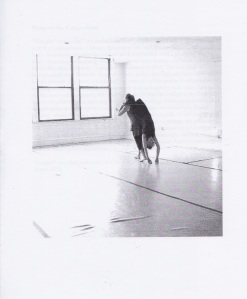
abovegroundpress.blogspot.comIt is notoriously difficult to capture one art form in another; can one do more than search for clumsy equivalents, fractured reflections? And yet when I read Carrie Olivia Adams’ Grapple for the first time, it was if I could see the movement and struggle of bodies in my mind. Not only the words themselves but the placement of the lines, fragments across a wide page, evoked extension and constriction, stillness and action.My first reading was without benefit of the “Notes on the Composition” which comes after the eight-page poem. I did have the image on the cover, and two inside, to know this was a dance in words. And the epigraph by Nawal El Saadawi told me that the poem was about movement and passivity, surrender and resistance. But it was only upon reading the notes that I understood the poem to actually be a text that had accompanied a dance performance–a performance inspired (if that’s the right term) by the arrest of “a young African American man during a protest as part of Moral Mondays Illinois in Chicago in November 2015.”The poem begins with two definitions of the title–“to stop the progress or movement of / (something)” and “to attract and hold the attention of / (someone or something).” This apparent contradiction, or mirror-imaging, is carried on throughout, with “strength” linked to “vulnerability” and going “limp” being an “act of resistance / …an act of / strength”. There is a particularly telling moment whenWe cannot see your face you cannot see ours pressedBut we are so closeThese words seem to me both powerful, frightening, and almost beautiful. On the poem’s next page, however, the poet becomes somewhat less nimble, writing in true, if sloganeering fashion, of a city that “forgets / the backs on which it is built”. But then the poet becomes more suggestive again:Tell us again how you knowhow you submerged us
how we re-wrote the movement of sidewalk and street
how it bent up to meet usThese words were spoken to a dance created by Chicago choreographers Jamie Corliss and Lydia Feuerhelm, who were also the performers. According to the “Notes,” the dance and the words were intended to “work with and against each other,” echoing the tension within the poem itself. I certainly would have liked to see this performance in which “intimacy and aggression overlap” but the poem works well on its own, especially with the accompanying photographs. It is a work that, while for the most part not allowing its political purpose to diminish its artistry, never forgets that purpose.
Subscribe to:
Posts (Atom)


